Student Researchers Breaking Barriers
A research paper on how engineering degrees teach sustainability, written with student and staff researchers at Queen Mary and UCL.
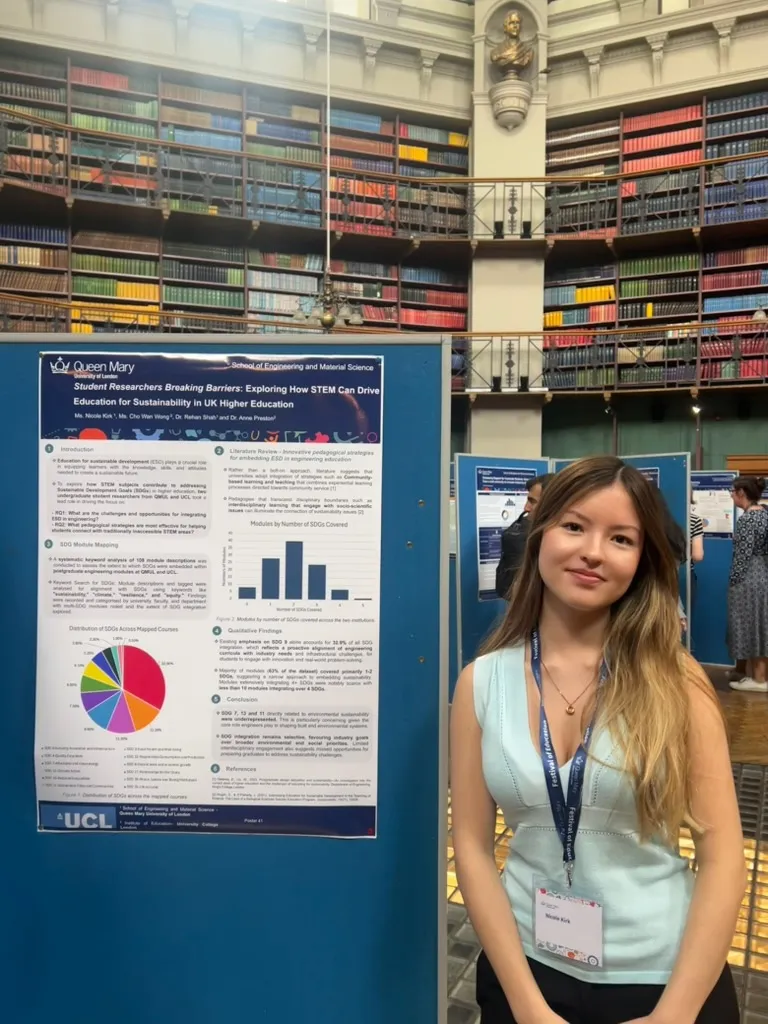
The poster, shared with two co-authors from UCL.
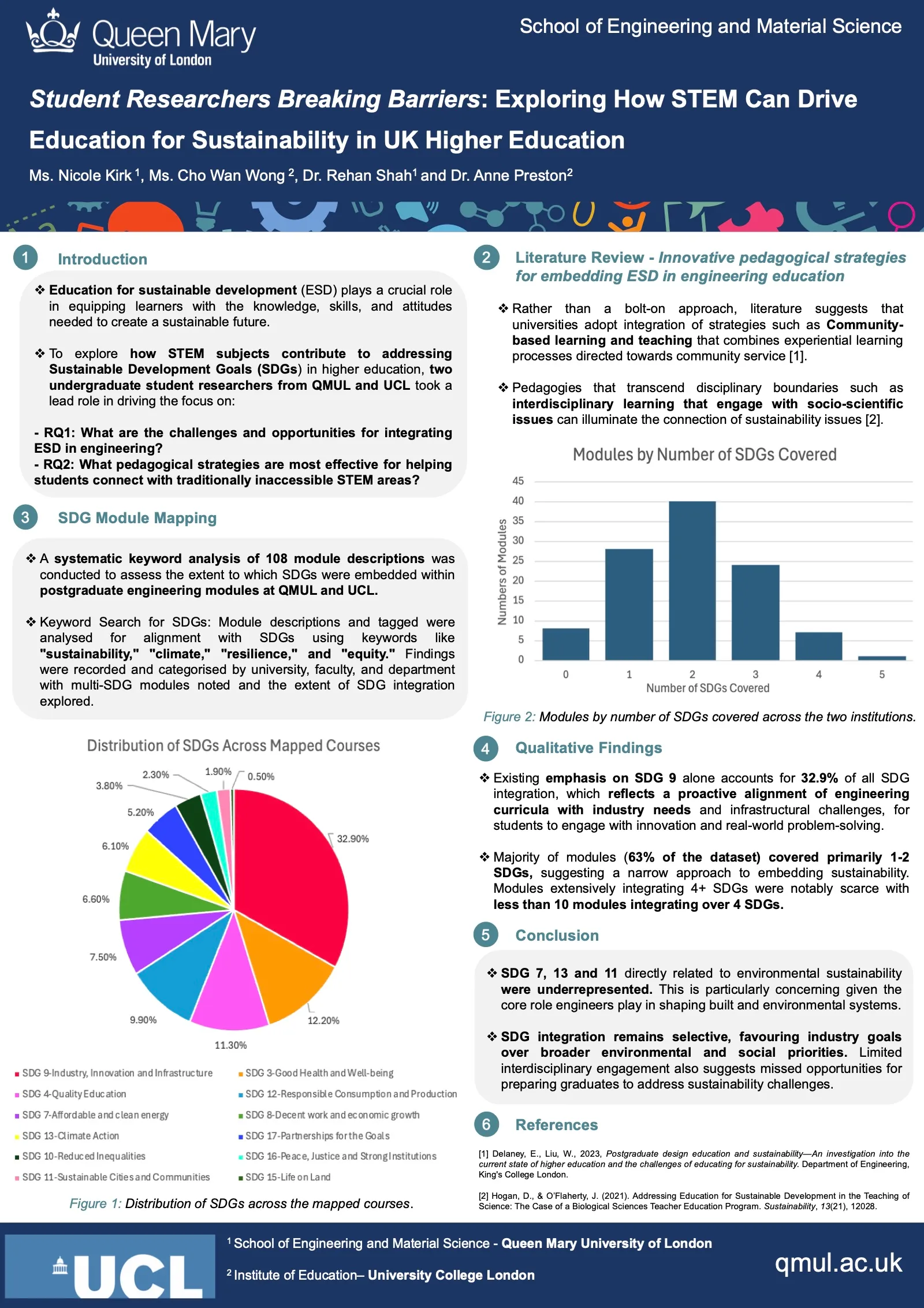
The question
RQ1What are the challenges and opportunities for integrating sustainability education into engineering?
RQ2Which teaching strategies help students connect with the parts of STEM that feel out of reach?
What we found
- 108
postgraduate engineering modules, from Queen Mary and UCL. Each dot is one module description.
Every description was searched for words like
and tagged with the UN Sustainable Development Goals it covers.
Sorted by how many of the 17 goals each one covers, the modules make a chart.
- 63%
cover just one or two goals: a narrow, focused approach to sustainability.
- 8
mention no goal at all, and only eight reach four or five. Even the broadest cover 29% of the goals.
Which goals get mentioned
Take every 100 times a module mentions a goal.
- 33
are SDG 9: industry, innovation and infrastructure. Curricula lean towards what industry needs.
- 56
once health and education are added. Three goals make up more than half of every mention.
- 16
go to clean energy, climate action and sustainable cities, the goals closest to what engineers build.
Conclusions
Sustainability is taught, but selectively. To prepare engineers for it, universities need to make it a core theme, not a bolt-on module.
It leans towards industry. SDG 9 alone is a third of every mention, and most modules cover one or two goals.
It misses the planet. Climate action, clean energy and sustainable cities, the goals closest to what engineers build, are underrepresented.
Some modules show the way. The ones covering the most goals share four approaches: active learning, interdisciplinary design, community-based projects and systems thinking.